So I’m no expert of labour or delivery, since I’ve only had one child, and every child and pregnancy is super different on every perspective and proportion. But I thought to share some important things that helped me through my first delivery, while I prepare myself mentally for my second baby due in 1 months time! EEEEE~!!!
Signs of Labour
There are three main signs of labour: contractions, bloody show, and water bag break. There are just so many things to understand and know about the labour process, and I’d recommend reading this comprehensive article.
- Contractions
- After reading the above linked article, the most important thing to know is when to go into the hospital. From my experience and what I’ve read:
- Be ready when your contractions get stronger, shorter in intervals, and longer in duration consistently.
- At what point of contractions do you go into the hospital? For first baby, go with the 4-1-1 rule, and for second baby onwards, go with the 5-1-1 rule. Which means regular, painful contractions at 4/5 minute intervals (from start of one contraction to the start of next contractions), each contraction lasting 1 minute, for over a 1 hour duration.
- I’d recommend using the contraction timer on the Baby Center app. Download the app (Apple/Google), click on Tools, then Contraction Timer. Click Start Timing when you feel a contraction coming on, let it peak and drop till you’re comfortable again, then click Stop Timing. Repeat this for every contraction. You will have a record of Length (duration), Time apart (interval), and exact timings; as well as an average in the last hour at the bottom. This is what you will be looking out for to apply the above 4-1-1 or 5-1-1 rule.
- Personal Experience: For my first baby, I started having contractions at about 1.30am, timed it till 3am. Within that 1.5 hours, contractions were getting closer and stronger, and was at about 6 minute intervals with 1 minute duration. So we decided to go in to the hospital at that point. Clearly, it wasn’t quite a 4-1-1 rule situation, but we figured 6-1-1.5 was close enough, hahah.
- After reading the above linked article, the most important thing to know is when to go into the hospital. From my experience and what I’ve read:
- Bloody Show
- This sounds scary, but it really isn’t. In fact, it’s quite normal. It’s basically discharge with a tinge of blood when your mucus plug (or what looks like a blob of thick mucus) comes out, and it’s your body telling you, “get ready, momma!!”. You may not have contractions at this point, and there’s no urgency to rush to the hospital. But if there’s a lot of blood like your usual period, call your doctor immediately.
- No personal experience on this, but I’ve a friends who had bloody show, and only went into the hospital 2 days – 1 week later.
- Water Bag Break
- Again, I don’t have experience with this, and I kinda hope I don’t cause this does scare me. But apparently, if the break isn’t obvious with a big gush of water, sometimes it can feel like a steady trickle of pee down your leg. Which feels so embarrassing, haha!
- But if your water bag does break, go in to the hospital immediately. Don’t wait. I do know of some mummies who still take a shower and eat a snack before going in, but doctor’s advise is: go in immediately. So take your pick? Haha.
Upon Arrival at Mt Alvernia Hospital
I can’t speak for other hospitals, but this was what happened for me at Mt Alvernia. If you’re delivering at Mt Alvernia, here’s a great guide on the hospital’s maternity facilities and procedures.
Once you arrive at the hospital, go to Medical Centre A. The nurses will offer a wheelchair if you’re in active labour, you may choose to walk if you prefer. Go up to Level 3, delivery ward.
Present your admission form to the front desk nurse, and inform her of your contraction duration and intervals. The nurses at the counter will assess if you’re in active labour or not. You may be advised to return home if you’re not in active labour yet. Which is probably a good thing because if you get checked in, and you lay in there for more than a day, you get charged extra $$. So just go home, and lay in bed for free. Haha.
In the Delivery Ward
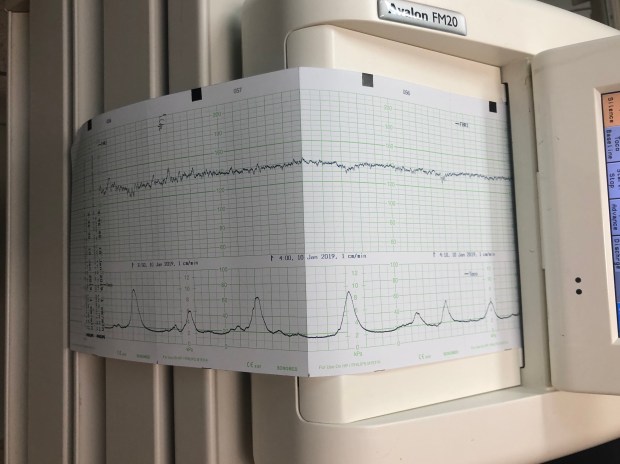
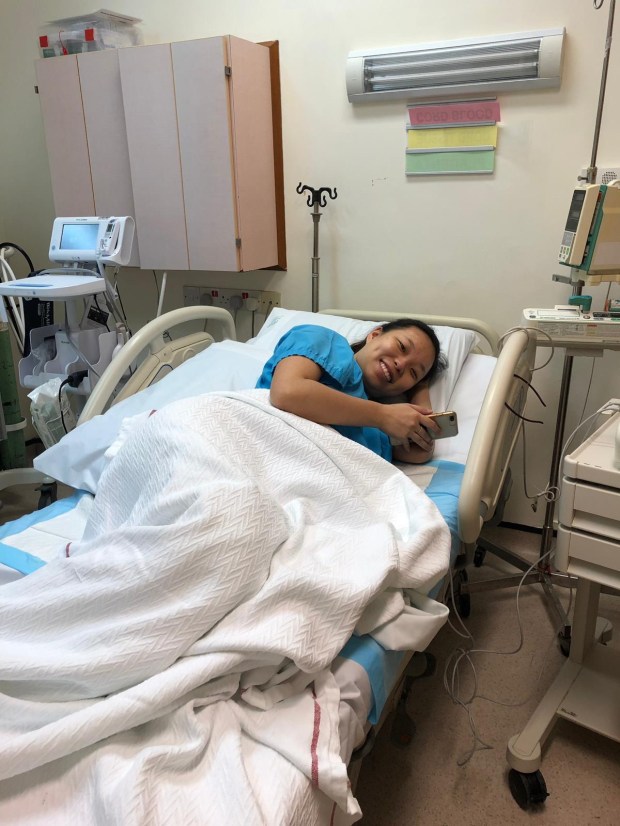
Once I was admitted into the delivery ward, I was strapped onto the CTG machine to check your contractions and a fetal heart rate monitor, given laxatives to clear my bowels (super effective, oh my), and had an IV line injected into my hand (hated this). My gynae came in to examine me, and proceeded to break my water bag. A catheter was also inserted to maintain an empty bladder, cause I wasn’t allowed to walk around anymore. I was given oxytocin to help expedite the dilation of my cervix as I was only at 1cm when warded, but it also caused the contractions to be stronger and closer in duration. I would not recommend taking oxytocin if you’ve a choice, unless it’s super critical.
From there, it was just a waiting game for dilation. In theory, my gynae said that dilation is about 1cm per hour. But in actuality, it was more like 10cm in 10 hours, which was somewhat true for us:
- 1am+: Contractions started
- 3.45am: in delivery ward
- 4am: 1cm (super slow dilation at the start)
- The nurses kept advising me to take epidural, but I did not want to until I had to. Reason being that I just wanted to feel what contractions felt like, haha. I’d say that each contraction is actually bearable with proper breathing techniques and a relaxed mind. What I kept thinking through each contraction was, “just relax and let your body do what its created to do“, that was pretty helpful. But what broke my will was my super slow dilation and physical exhaustion, so I decided to take the epidural in the end because I didn’t wanna pass out with fatigue before pushing, and end up with a C-Sect, haha!
- 9am: 4cm (I took Epidural at this point)
- Was pretty anxious about this earlier on because of how the procedure sounded, but honestly I did not feel the needle at all despite the doctor attempting to insert in three times because I kept shaking/moving from the contractions. But yeah, I was a jellyfish from tummy to toes there after, and slept all the way until it was time to push cause I was so exhausted from a night without rest.
- Also, note that it takes the doctor 30-45min to get to you upon request for epidural, and another 30min for it to take effect. So don’t wait too long if you’re in too much pain.
- 12pm+: 7cm (sudden 3cm dilation)
- 1pm+: 10cm (TIME TO PUSHHHH!)
- At Mt Alvernia, the nurses will prep you very quickly, then instruct you to practice pushing before it’s really time for birthing. Once it is prime time, they will ask you to push for 10 seconds once the contraction is at its peak. They will count 1 to 10 for you while you bear down and push. Remember to engage your abs muscles and pushhhhh!
- 1.44pm: Baby came out!

After Delivery
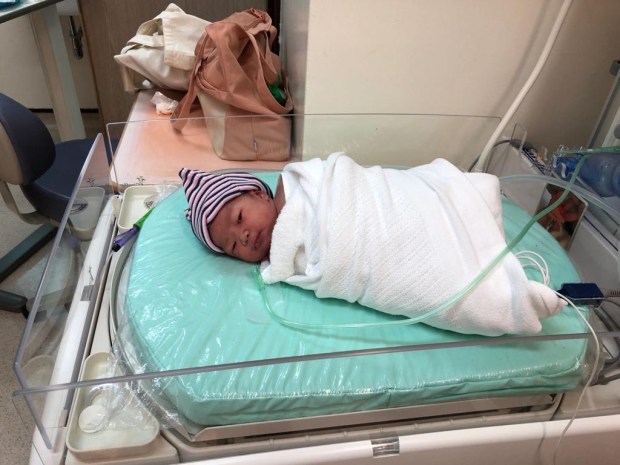
Once baby pops, papa cuts umbilical cord, and baby gets the preliminary checks, you will get skin-to-skin time with baby. Honestly, I was not overwhelmed with emotions or felt a great love for my girl. Instead, I just could not even wrap my head around the fact that this baby is mine!!! Haha. But I really enjoyed cuddling her, nursing her, and slowly getting to know this stranger that’s been growing inside of me.
While doing so, your placenta gets removed, and you get cleaned up from all the blood, gunk, and beautiful mess from child birthing.
Total Expenditure in 2019
I’m not sure if this will be helpful info, but I really wanted to know how much other parents were spending for their whole pregnancy and delivery. So I thought I’d share the summary breakdown of our estimated expenditure for our first child.
- Pre Natal Check-Ups w discounted package ($1300): $3887.14
- Hospital Deposit: $2259
- Hospital Fee after medisave, discounts: $3902.17
- Post Natal Check-Ups: $131.58
- Baby Check-Ups: $179.76
- Total Spent: $10,359.65 (after Medisave claimable: $3,050 + $1,350 & t Alvernia Card discount of $80. The actual total was $14,839.65)
 byamandagrace